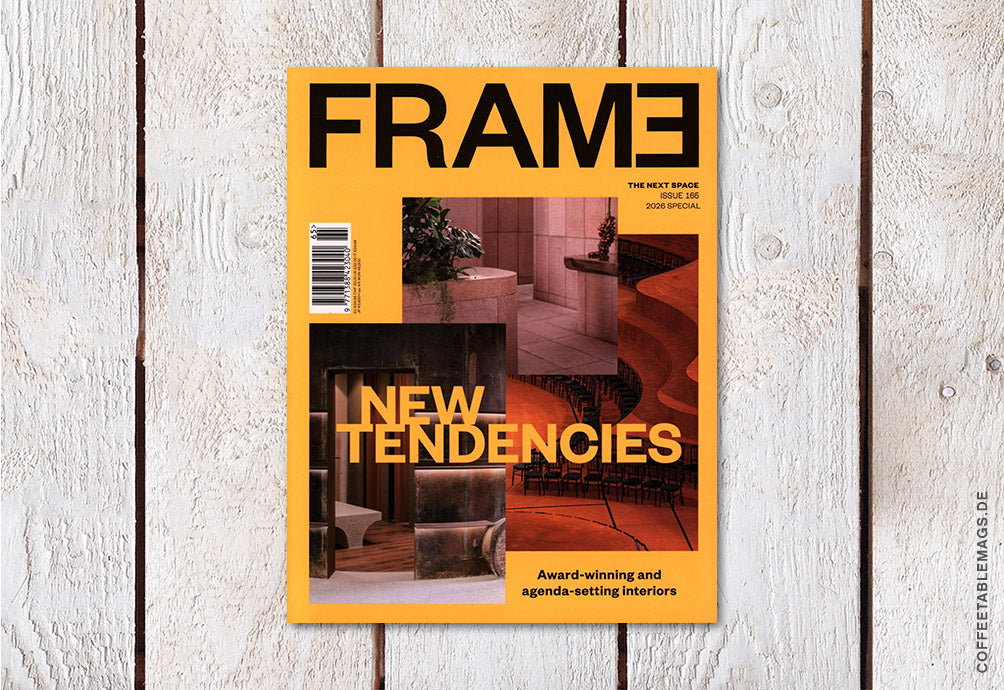
Frame Magazine – Number 165: The state of spatial design
Shipping from €4.90 (DE) · EU from €9.90 · See full rates.
Couldn't load pickup availability
The Great Indoors
FRAME Uncovered: take a sneak peek inside FRAME 165, our Awards issue.
Our 2026 special issue honours the recent FRAME Awards winners and predicts what lies ahead for spatial design, as editor in chief Floor Kuitert explains.
Reflection and projection are the two ideas that under-pin our annual special issue. As the first issue of the year, it takes stock of the state of spatial design. Its primary source is the FRAME Awards 2025: the projects and people that, according to our jury of industry experts and in-house editorial team, represent the very best of spatial design over the past year. Together with insights from the jury sessions, they highlight what currently carries weight in interior design and offer cues as to where the discipline is headed.
This year, reflection and projection are not only evident in the issue’s intent and structure, but woven into the very fabric of the projects and stories it contains – in more ways than one.
In many of the winning projects, heritage forms the backbone of spatial innovation. Here, preservation is not an end in itself but a catalyst for change – tradition used as a framework for progress. Aim Architecture, named Designer of the Year, articulates this approach clearly: ‘Every site, every building and every piece of history offers a starting point and a story to continue, rather than a chapter to close,’ says cofounder Wendy Saunders. ‘We try to preserve the emotional essence of a place and the qualities that make it meaningful, while also daring to imagine how it can be made relevant today and in the future. This approach is never just about material restoration. It’s about activation: turning heritage into a living stage where new experiences can unfold.’ By intertwining the old with the new, and memory with possibility, the studio creates spaces that are resilient – not because they resist change, but because they embrace it.
Aim’s work is far from the only example of this thinking taking shape. In Barcelona, Sigla Studio balances architectural integrity with contemporary living in the Large Apartment of the Year, a project commended by the jury for its ‘dialogue between architectural heritage and contemporary design sensibilities’ and its ‘exemplary calibration of old and new’. In Beijing, Yatofu Creatives transformed monumental tanks into the structural and symbolic framework for a retail environment rooted in community and industrial history, earning the title of Multi-Brand Store of the Year. In Belgium, OYO situated the Co-Working Space of the Year in a monumental building originally constructed in 1885 as a circus, honouring its past while reimagining it as a contemporary hub for creativity and collaboration.
Elsewhere among the awardees, reflection and projection surface through more fundamental challenges to inherited spatial norms. The Small Apartment of the Year in San Sebastián, for instance, was reimagined by Medina Manzano Architects as a flexible response to contemporary housing needs and praised by the jury for how its reconfigurable character ‘lets the apartment pivot between living setups that go beyond the nuclear-family script’. Similarly ‘off script’, a women’s shelter in Toronto features an open, fluid ground floor that deliberately departs from rigid institutional layouts. Here, LGA Architectural Partners drew on Indigenous design principles to shape the project’s spatial logic.
To further distil and unpack the insights emerging from this year’s Awards submissions, we introduced an additional layer of projection. Four briefings examine the spatial and strategic shifts reshaping the sectors at the heart of FRAME – retail, hospitality, work and living – and trace the outlines of what lies ahead.
On a more personal note, reflecting on the 2025 FRAME Awards ceremony during the Workspace Design Show Amsterdam, one impression stands out: a strongly felt sense of community – itself a recurring thread in many of this year’s winning projects. The Awards show was a full house, with shortlisted studios travelling from near and far. It served as a reminder that spatial design is shaped not only by ideas and the spaces they produce, but also by the networks of people who gather around them.
We hope to build on that sense of collective momentum with our next FRAME Awards edition, for which submissions are now open. We look forward to seeing how the trajectories traced here begin to shift, diverge and extend.
Language: English
Share